Nederlands
 English
 Deutsch
 Français
 Español
 Português





National EV Charger Rollout Targets: Infrastructure Timelines and Standards
The United States is accelerating its electric vehicle charging infrastructure rollout with ambitious national targets for 2025-2026, driven by federal initiatives, state-level implementation, and major industry shifts toward standardized charging systems. The transition represents one of the most significant infrastructure transformations in recent American history.
Federal Push and NEVI Program Funding
The Federal Highway Administration (FHWA) is implementing a significant policy shift that supercharges state-level electric vehicle charging infrastructure plans. This federal initiative aims to accelerate the deployment of EV chargers across the United States, with a focus on supporting state-level implementation strategies. The policy changes are designed to streamline processes and provide enhanced support for states to expand their EV charging networks.
The cornerstone of this effort is the National Electric Vehicle Infrastructure (NEVI) Formula Program, which provides $4.155 billion in federal funding through 2026. States must submit annual deployment plans for FHWA review, with all FY22/23 plans approved in September 2022 and FY24 plans approved in November 2023. The program offers up to 80% funding for eligible costs including charger acquisition, installation, network connection, operation, maintenance, and data sharing.
'This federal-state partnership represents a major step toward achieving national EV infrastructure goals and addressing range anxiety concerns for electric vehicle owners,' says a transportation policy analyst familiar with the program.
The NACS Standardization Revolution
Perhaps the most significant development in EV charging is the rapid adoption of the North American Charging System (NACS), originally developed by Tesla and now codified as SAE J3400. This compact combined AC/DC charging connector is becoming North America's unified EV charging standard, with all major automakers committing to adopt it starting in 2025.
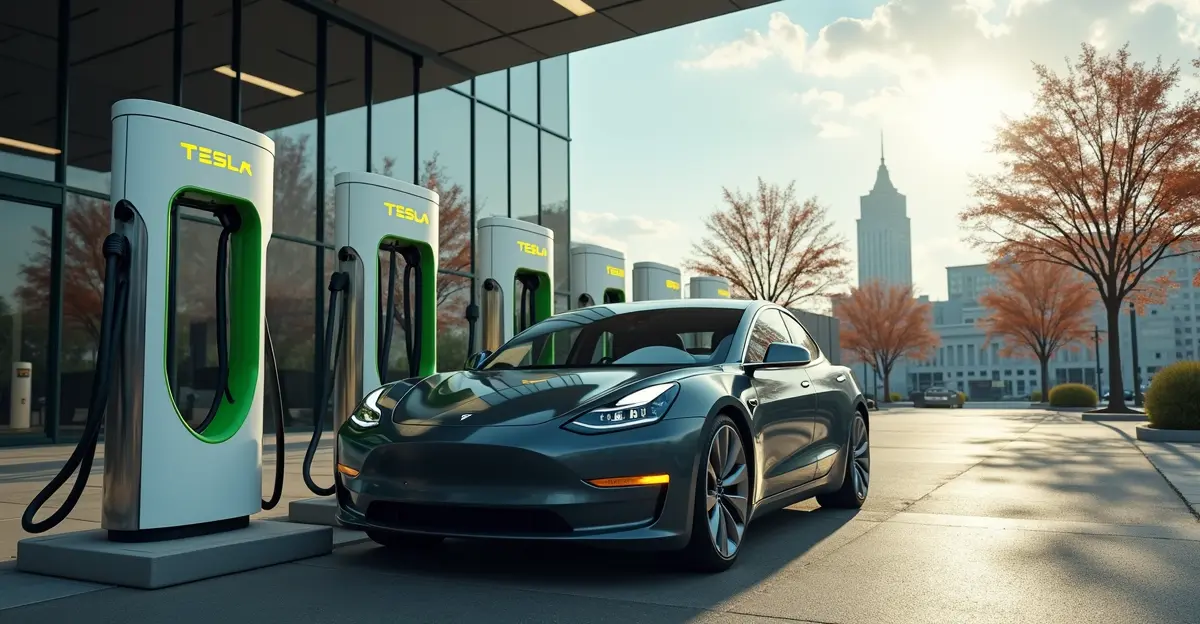
Tesla's Supercharger network currently has over 36,500 stalls for Teslas, 25,000+ stalls for NACS-compatible vehicles, and 2,400+ stalls for other EVs. Throughout 2025, Tesla's North American Supercharging network is opening to more automakers, with drivers initially using adapters before new EVs come with built-in NACS ports.
'The shift to NACS promises improved charging convenience and access to Tesla's reliable Supercharger network, though the transition period will involve adapters and some temporary complexity,' notes an industry expert from U.S. News & World Report.
Major Network Operators' Expansion Plans
Leading charging network operators are executing aggressive expansion strategies to meet growing demand. Electrify America, North America's largest DC fast-charging network, recorded impressive growth in 2024 with over 16 million charging sessions (50% increase) and 600+ GWh of energy delivered (65% increase).
For 2025, Electrify America plans a 30% network expansion, potentially adding 1,400 new chargers to reach over 6,200 total. The company will focus on larger stations (10+ stalls), introduce NACS (SAE J3400) connectors, and continue using Battery Energy Storage Systems at 17% of stations to manage demand load.
'We're positioned to support EV adoption by bringing high-quality charging infrastructure directly into communities,' says Electrify America President and CEO Robert Barrosa, emphasizing their expertise in building over 250 stations in California and more than 900 across North America.
State Implementation and Timeline Challenges
States face significant challenges in meeting the ambitious rollout timelines. According to a GAO report, key obstacles include grid capacity limitations, complex permitting processes, workforce development needs, and equity considerations for underserved communities.
The Federal Highway Administration provides detailed 5-year funding allocations for the NEVI program, with California receiving the largest allocation at $383.7 million, followed by Texas at $407.8 million, and Florida at $198.1 million. The funding is distributed annually, with $615 million allocated for FY 2022 and $885 million each for FY 2023-2026.
Interoperability and Future Outlook
The transition to standardized charging systems represents a critical step toward creating a seamless national charging network. The Charging USA 2026 event focuses on how strategic alliances can accelerate America's electric vehicle expansion, bringing together industry stakeholders to explore collaborative solutions.
As the industry moves toward 2026 targets, key metrics show progress: average energy per session has improved to 37.5 kWh, and each charger now serves about 9 vehicles daily. The proliferation of charging stations, driven by both private providers and government investment, remains a key influence on consumer behavior in the transition from internal combustion engine vehicles to electric vehicles.
'This isn't just about building chargers—it's about creating an integrated ecosystem that supports the entire EV transition,' concludes a senior transportation official involved in the national rollout.