


 Deutsch
 English
 Español
 Français
 Nederlands
 Português


 Share
Share




The Great Semiconductor Race Accelerates
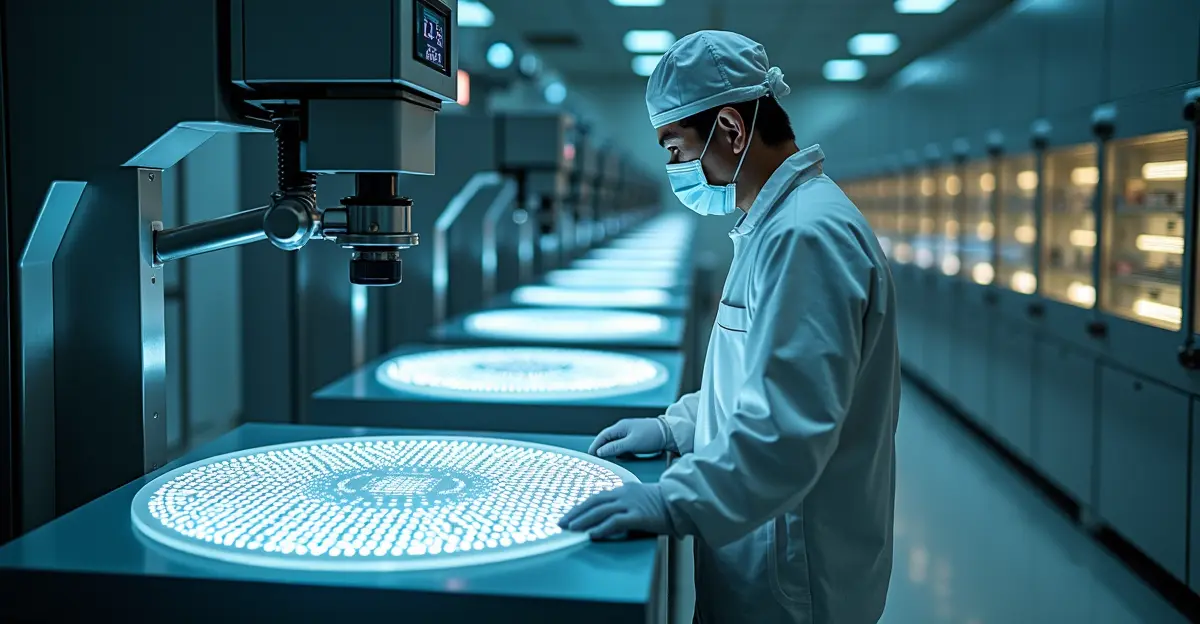
The global semiconductor industry is undergoing its most significant capacity expansion in decades, driven by unprecedented demand for artificial intelligence chips, geopolitical tensions, and massive government incentives. As we move through 2025 and into 2026, companies are pouring billions into new fabrication plants worldwide, fundamentally reshaping technology supply chains and creating ripple effects across markets and communities.
Record Investments and Aggressive Expansion
Taiwan Semiconductor Manufacturing Company (TSMC), the world's largest contract chipmaker, is leading the charge with plans to spend $52-56 billion in capital expenditures in 2026 alone—a staggering 40% increase from 2025's $40.9 billion. 'We have strong conviction on the AI mega trend,' stated TSMC's CFO, explaining the company's aggressive investment strategy. Approximately 70-80% of this budget targets advanced process technologies, with the remainder allocated to specialty technologies and advanced packaging.
TSMC's Arizona expansion represents one of the most ambitious projects, with the company purchasing additional land and planning a 'gigafab cluster' in the state. The first Arizona fab is already producing chips with yields comparable to Taiwan facilities, demonstrating that manufacturing excellence can be replicated in the U.S. 'The company has moved up production timelines for its second plant to late 2027 and is accelerating construction on a third facility while applying for permits for a fourth,' according to recent reports.
Geopolitical Drivers and Policy Impacts
The U.S. CHIPS and Science Act, signed in 2022 with $52.7 billion in federal incentives, has become a major catalyst for domestic semiconductor manufacturing. Research from Brookings Institution shows the legislation created between 42,465 and 54,385 jobs and increased wages in 149 counties with semiconductor manufacturing facilities. Semiconductor jobs saw weekly wage increases of $206-$232—25-28% over baseline levels.
By 2024, private-sector commitments linked to CHIPS incentives exceeded $600 billion across 130 projects in 28 states, with annual manufacturing investments surging to $90 billion from under $7 billion pre-2020. 'The Act is creating over 500,000 American jobs, including 69,000 permanent high-skill positions at fabrication facilities, 122,000 construction jobs, and 335,000 roles in supplier networks,' according to industry analysis.
Market Dynamics and AI Demand
The semiconductor market is experiencing what analysts call a 'tale of two markets' dynamic. AI-focused companies are significantly outperforming while those in automotive, computer, smartphone, and communications sectors face challenges. According to Deloitte Insights, chip sales are expected to reach $697 billion in 2025, setting a new all-time high following robust 2024 performance with 19% growth to $627 billion.
Generative AI chips are a major driver, with 2024 sales estimated at over $125 billion (20% of total chip sales) and predicted to exceed $150 billion in 2025. The industry is on track to reach the $1 trillion goal by 2030, requiring only 7.5% CAGR from 2025-2030.
Community Impacts and Workforce Development
The expansion is creating significant community-level impacts. The Columbia University research on CHIPS Act employment impacts reveals both direct job increases of 14,900-20,860 in semiconductor production and related manufacturing, plus indirect gains of 27,565-33,525 jobs in upstream sectors and construction.
However, the industry faces challenges including talent shortages and the need for specialized training programs. 'While the employment gains are modest relative to the $52.7 billion investment, they exceed expectations given the semiconductor industry's capital-intensive nature,' noted researchers from Northeastern and Columbia Universities.
Global Competition and Supply Chain Resilience
Beyond the U.S., other regions are also expanding capacity. TSMC is building facilities in Japan and Europe, while Intel is re-emerging as a potential alternative manufacturing source. 'Intel's manufacturing offers geographic diversification aligned with US industrial policy, and the company has seen its shares rise 19% in 2026 amid renewed investor confidence,' according to industry reports.
The explosive growth in AI demand is straining semiconductor manufacturing capacity, with TSMC informing major clients like NVIDIA and Broadcom that it cannot fully satisfy demand for cutting-edge AI processors. This supply-demand imbalance is driving further investment and innovation across the sector.
Future Outlook
As we look toward 2026 and beyond, the semiconductor capacity expansion shows no signs of slowing. The World Semiconductor Trade Statistics forecast indicates continued strong growth in the global semiconductor market through 2026. The industry's transformation from a primarily Asia-centric manufacturing base to a more geographically diversified ecosystem represents one of the most significant industrial shifts of our time.
The capacity expansion is not just about building more factories—it's about creating resilient supply chains, advancing strategic technology capabilities, and positioning nations for economic competitiveness in an increasingly digital world. As one industry executive noted, 'This isn't just about chips; it's about securing our technological future.'




Follow Discussion