


 Deutsch
 English
 Español
 Français
 Nederlands
 Português


 Share
Share




Mali Confirms Death of Defense Minister Sadio Camara
Mali's state television confirmed on April 26, 2026, that Defense Minister General Sadio Camara was killed in a suicide truck bombing at his residence in the garrison town of Kati, approximately 15 kilometers northwest of the capital Bamako. The attack was part of a massive, coordinated wave of assaults launched by an unprecedented alliance between the al-Qaeda-linked jihadist group JNIM (Group for the Support of Islam and Muslims) and Tuareg separatists of the Azawad Liberation Front (FLA), marking the most significant escalation in Mali's conflict since the 2012 rebellion.
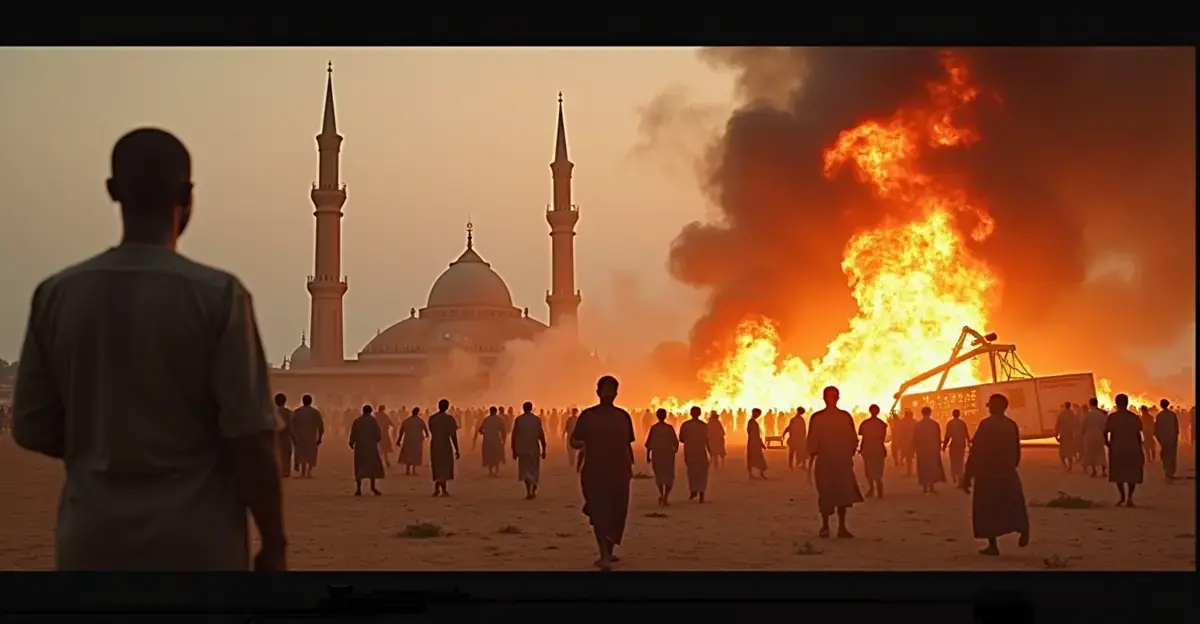
The bombing, which involved a vehicle-borne improvised explosive device (VBIED), completely destroyed Camara's residence and a neighboring mosque, killing the 47-year-old general along with his second wife, two grandchildren, and several worshippers at the mosque. According to the official account, Camara initially returned fire on the attackers before succumbing to his wounds at a hospital. At least 16 others were injured in the overall offensive, according to government spokesperson Issa Ousmane Coulibaly.
Background: A Nation Under Siege
Mali has been gripped by instability since the 2012 Tuareg rebellion and subsequent jihadist takeover of northern Mali. The situation worsened after Colonel Assimi Goïta seized power in back-to-back coups in 2020 and 2021, promising to restore security. Instead, the junta expelled French forces and deepened ties with Russia, bringing in mercenaries from the Africa Corps (formerly Wagner Group). However, violence has only intensified, with jihadist groups expanding into central and southern Mali. The Sahel security crisis has become a major concern for regional and international actors.
General Sadio Camara, born March 22, 1979, was a key figure in the junta. He participated in the 2020 coup that ousted President Ibrahim Boubacar Keïta and served as defense minister under Goïta. The United States had sanctioned him in July 2023 over links to the Wagner Group, though those sanctions were lifted in February 2026, just two months before his death.
The Coordinated Offensive: A New Alliance
The April 25-26 attacks were unprecedented in scale and coordination. JNIM, the al-Qaeda affiliate in the Sahel, and the FLA, a secular Tuareg separatist movement seeking an independent state of Azawad in northern Mali, jointly targeted multiple cities simultaneously. This rare cooperation between Islamist militants and separatist rebels — former adversaries — represents a major strategic shift.
Key Targets and Outcomes
- Kati (Bamako suburb): Suicide car bomb attack on Defense Minister Camara's residence; Goïta's home was also targeted but he was moved to safety.
- Bamako: Attacks on the international airport and military installations; curfew imposed from 21:00 to 06:00 local time for three days.
- Kidal: The northern stronghold fell to FLA forces after two days of clashes. Russian Africa Corps mercenaries negotiated a withdrawal and left the city, which is now under full rebel control.
- Gao: Partially captured by the coalition; the FLA has declared its intention to seize the entire city and then move on to Timbuktu.
- Mopti and Sèvaré: Military positions attacked, with varying levels of success for the insurgents.
According to the Long War Journal, the offensive was the largest since 2012. A FLA spokesperson told the BBC that the operation was planned for months. The coalition's ability to strike heavily fortified areas, including the junta's own stronghold in Kati, highlights the deteriorating security situation and the regime's vulnerability. The growing influence of al-Qaeda in the Sahel is a worrying trend for regional stability.
Impact on the Junta and Regional Stability
The killing of a high-ranking government official is a severe blow to the legitimacy of Colonel Assimi Goïta's junta, which has ruled for five years without delivering on promises of security. Goïta, who had his transitional presidency extended until at least 2030 by the National Transitional Council in July 2025, now faces the gravest challenge of his tenure. The attacks also expose the limits of Russian military support. The Africa Corps forces, which replaced the Wagner Group after its rebranding, were forced to withdraw from Kidal under negotiated terms — a humiliating retreat that undermines the narrative of Russian effectiveness.
International reaction has been swift. United Nations Secretary-General António Guterres condemned the violence and called for coordinated international support to address extremism in the Sahel. The African Union, the Economic Community of West African States (ECOWAS), the Organization of Islamic Cooperation, the European Union, and the United States all issued statements denouncing the attacks and expressing condolences. The African Union specifically condemned the endangerment of civilians.
The offensive has also raised fears of a broader regional spillover. Mali's neighbors — Niger, Burkina Faso, Mauritania, Algeria, and coastal West African states — are all vulnerable to similar attacks. The spread of jihadist violence across West Africa could destabilize the entire region.
FAQ
Who was Sadio Camara?
Sadio Camara was a Malian army general and the Minister of Defense under junta leader Assimi Goïta. He played a key role in the 2020 coup and was a central figure in the military government, known for his close ties to Russia's Wagner Group/Africa Corps.
Who carried out the attack?
The attack was jointly carried out by JNIM (Jama'at Nusrat al-Islam wal-Muslimin), an al-Qaeda affiliate, and the Azawad Liberation Front (FLA), a Tuareg separatist group. This marks the first large-scale coordinated operation between the two former rivals.
What is the current situation in Mali?
Mali remains under a state of emergency. A curfew is in place in Bamako and other affected cities. The northern city of Kidal is under FLA control, while fighting continues in Gao and other areas. The junta claims it has repelled attacks in some locations, but independent verification is limited.
How has the international community reacted?
The UN, AU, ECOWAS, EU, US, and OIC have all condemned the attacks. The UN chief called for international support to combat extremism in the Sahel. No military intervention has been announced, but diplomatic pressure is mounting.
What does this mean for the future of Mali?
The offensive represents the biggest challenge to the junta since it took power. It exposes the failure of the regime's security strategy and the limitations of Russian military support. The alliance between JNIM and FLA could reshape the conflict, potentially leading to further territorial losses for the government and increased instability across the Sahel.
Follow Discussion