


 Deutsch
 English
 Español
 Français
 Nederlands
 Português


 Share
Share




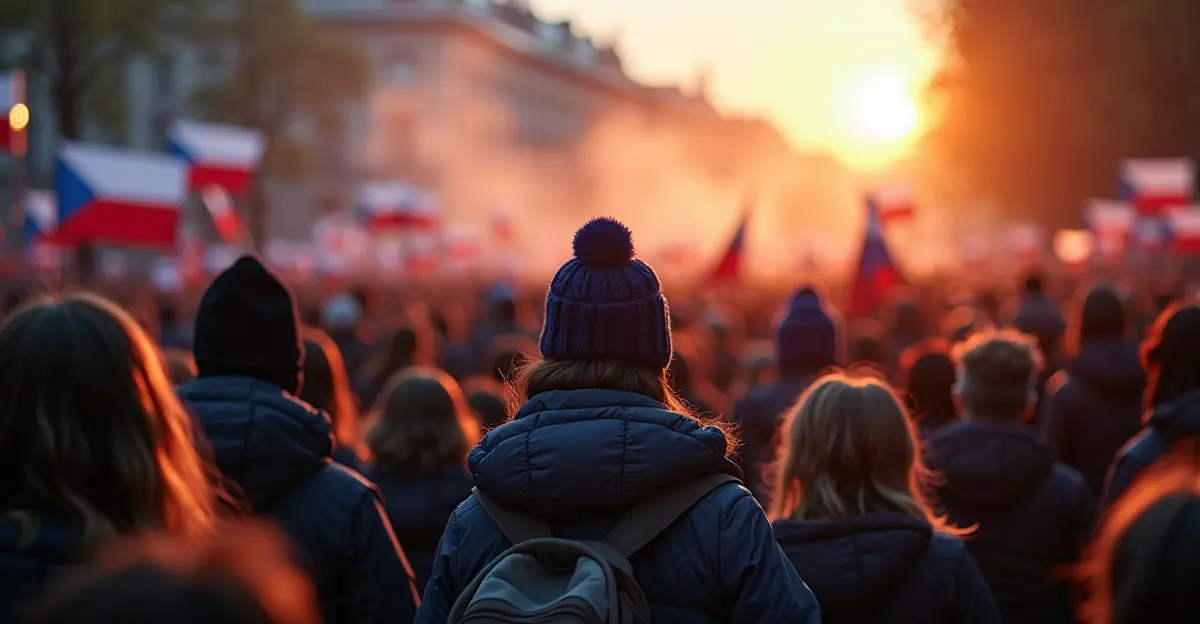
Thousands of demonstrators marched across 12 Czech cities on May 17, 2026, in one of the largest coordinated protests in recent years, defending the independence of public broadcasting against a government plan to overhaul its funding model. The protests, organized by the civic movement 'A Million Moments for Democracy,' signal deepening public concern over democratic backsliding in the Central European nation.
What is the Czech public media reform proposal?
The ruling coalition government of Prime Minister Andrej Babiš — comprising the centrist ANO 2011 party alongside the far-right SPD and the Motorists movement — has proposed abolishing the mandatory television and radio licence fees that currently fund Czech Television (ČT) and Czech Radio (ČRo). Under the draft law presented by Culture Minister Oto Klempír, both broadcasters would instead receive a fixed allocation directly from the state budget starting in 2027, with significantly reduced funding. Czech Television would operate on 5.74 billion crowns (approximately €234 million), down from the current 8.5 billion crowns, while Czech Radio would receive 2.07 billion crowns — about 400 million crowns less than its current licence fee revenue.
Why are Czechs protesting?
Critics argue the reform is a thinly veiled attempt to bring public media under political control, echoing tactics used by Hungarian Prime Minister Viktor Orbán and Slovak Prime Minister Robert Fico. 'They want to take over the media like Orbán did, but more cunningly,' said Libor Bríza, a protester in Brno. 'The measures seem innocent and purely about financial structure, but they can have far-reaching consequences. That's why we're taking to the streets now, before it's too late.'
The Czech Republic currently ranks 11th on the Reporters Without Borders World Press Freedom Index — above Germany and Belgium — but experts warn the proposed changes could erode that standing. The Vienna-based International Press Institute warned the plan could weaken broadcasters' financial stability and their ability to fulfill public service obligations. Media labor unions have entered a strike alert, prepared to walk out if the legislation proceeds.
Demonstrators in Brno marched past the Czech Radio building, where employees hung out of windows waving back at the crowd. 'Thank you!' protesters chanted. 'No, thank you!' radio staff replied. The scene captured the solidarity between journalists and the public. The Czech public broadcasting crisis has become a flashpoint for broader anxieties about the rule of law.
Parallels with Hungary and Slovakia
Protesters explicitly fear the Czech Republic could become 'the new Hungary.' In Hungary, Orbán systematically dismantled independent media after 2010, turning the public broadcaster into a government mouthpiece. In neighboring Slovakia, the government of Robert Fico replaced the public broadcaster's leadership with pro-government appointees shortly after taking office in 2023, gradually replacing journalists and presenters. 'Without a public broadcaster, we'll only have small newspapers and podcasts left. That's not enough,' said one demonstrator in Brno.
However, key differences exist. Babiš governs with a coalition of three mutually competing parties and lacks a majority in the Senate. He also faces resistance from the president, who belongs to the opposition, and from a strongly pro-European population. The EU democratic backsliding concerns are particularly acute in Brussels, which has watched developments in Prague with growing unease.
Government's defense and legal ambiguities
The government frames the reform as a necessary cost-cutting measure, claiming it will save 1.4 billion crowns (€57 million). Babiš has long fulminated against what he calls the broadcaster's alleged bias, particularly after investigative journalists uncovered conflicts of interest involving his Agrofert business empire and misuse of EU subsidies, leading to criminal prosecution — which the coalition recently made impossible to pursue.
Culture Minister Klempír insists the broadcaster's governance structure will remain unchanged. However, the broadcasters' boards say the new media law deliberately contains legal ambiguities that could enable future content-based interventions. Unrealistic demands are also included, such as a requirement to make radio broadcasts accessible to deaf and hard-of-hearing audiences.
What happens next?
The coalition council is scheduled to discuss the draft law on May 25. If approved, it will go before the government and then Parliament. The earliest possible implementation is 2027. The protest movement has vowed to keep up the pressure. Vera Schöbl, a 72-year-old former doctor who grew up under communism, was moved by the turnout. 'I didn't expect so many people, young and old, to come. I don't want to go back to those times. Never again.'
Filmmaker and demonstrator David Schöbl remains cautiously optimistic: 'Our system is still good, but the government is looking for every way to push through its plans.' He says he will keep protesting. 'Until it's no longer possible. Then I'll leave.' The impact on Czech press freedom will be closely watched by media watchdogs worldwide.
Frequently Asked Questions
What is the Czech government proposing for public media?
The government wants to abolish the mandatory licence fee for Czech Television and Czech Radio, replacing it with direct state budget funding at a reduced level — effectively cutting the broadcasters' budgets by roughly one-third.
Why are people protesting?
Protesters fear the reform will make public broadcasters financially dependent on the government, opening the door to political interference and editorial control, similar to what happened in Hungary and Slovakia.
How many people have protested?
On May 17, 2026, thousands marched in 12 cities across the Czech Republic. Earlier protests in Prague this year drew an estimated 200,000 people.
What is the current state of press freedom in the Czech Republic?
The Czech Republic ranks 11th globally on the Reporters Without Borders Press Freedom Index (2026), one of the highest positions in Central and Eastern Europe.
When could the reform take effect?
If approved by the government and Parliament, the new funding model could take effect in 2027.
Follow Discussion