


 Deutsch
 English
 Español
 Français
 Nederlands
 Português


 Share
Share




Global Water Crisis: The Next Major Conflict Driver?
As the world enters 2026, water scarcity has escalated from an environmental concern to a primary geopolitical risk, with experts warning that water stress could become the next major driver of international conflict. According to the Eurasia Group's 2026 political risk report, water scarcity and cross-border water management now rank among the top global threats, affecting over half the world's population who face severe water scarcity at least one month per year. This comprehensive analysis examines the water scarcity hotspots and infrastructure stress points that are transforming water from a basic resource into a strategic weapon.
What is the Global Water Crisis?
The global water crisis refers to the growing mismatch between freshwater availability and human demand, exacerbated by climate change, population growth, and unsustainable management. There are two primary types: physical water scarcity, where there's simply not enough water (common in arid regions like the Middle East), and economic water scarcity, where infrastructure and investment limitations prevent access to available water (prevalent in sub-Saharan Africa). Approximately 2.3 billion people live in nations with water scarcities, defined as having less than 1,700 cubic meters of water per person annually.
Critical Water Scarcity Hotspots Identified
A groundbreaking 2026 study from Utrecht University, supported by the National Geographic Society, has identified 21 global water scarcity hotspots classified into 7 distinct clusters based on their primary challenges:
- Water Treatment & Desalination: Arabian Peninsula nations
- Hydroclimatic Change: Central Chile, Spain, Australia, Japan
- Agricultural Water Use: North China Plain, California, and 6 other regions
- Population Growth: Indus and Ganges River Basins
- Surface & Groundwater Depletion: Coastal Peru and Iran
- Land Subsidence: Mexico, Java, Vietnam
- Virtual Water Trade: Thailand and agricultural export regions
These hotspots represent regions where human water demand consistently exceeds renewable supply, creating conditions ripe for tension and conflict.
Infrastructure Under Stress: The Aging Dam Crisis
Global Dam Safety Concerns
Water infrastructure worldwide is facing unprecedented stress from climate change and aging systems. A 2025 Nature Water study analyzing dam failures since 1900 reveals alarming trends: 23 large dam failures are predicted worldwide between 2023-2035, with about 4.4% of large dams having failure probabilities exceeding the 1/10,000 safety threshold. The research shows that dam age, climate patterns, and economic disparities are key drivers of failure risk.
U.S. Infrastructure at Breaking Point
In the United States, over 91,000 dams average 57 years old, with more than 8,000 over 90 years old. The American Society of Civil Engineers gives U.S. dams a 'D' grade, noting that 70% will be over 50 years old by 2030. Climate change is exacerbating these risks, with extreme weather events becoming more frequent and intense. The near-failure of Minnesota's Rapidan Dam in June 2024 highlighted the growing dangers, with rehabilitation costs for all nonfederal dams estimated at $157.7 billion.
Geopolitical Flashpoints: Where Water Could Spark Conflict
The Nile River Basin
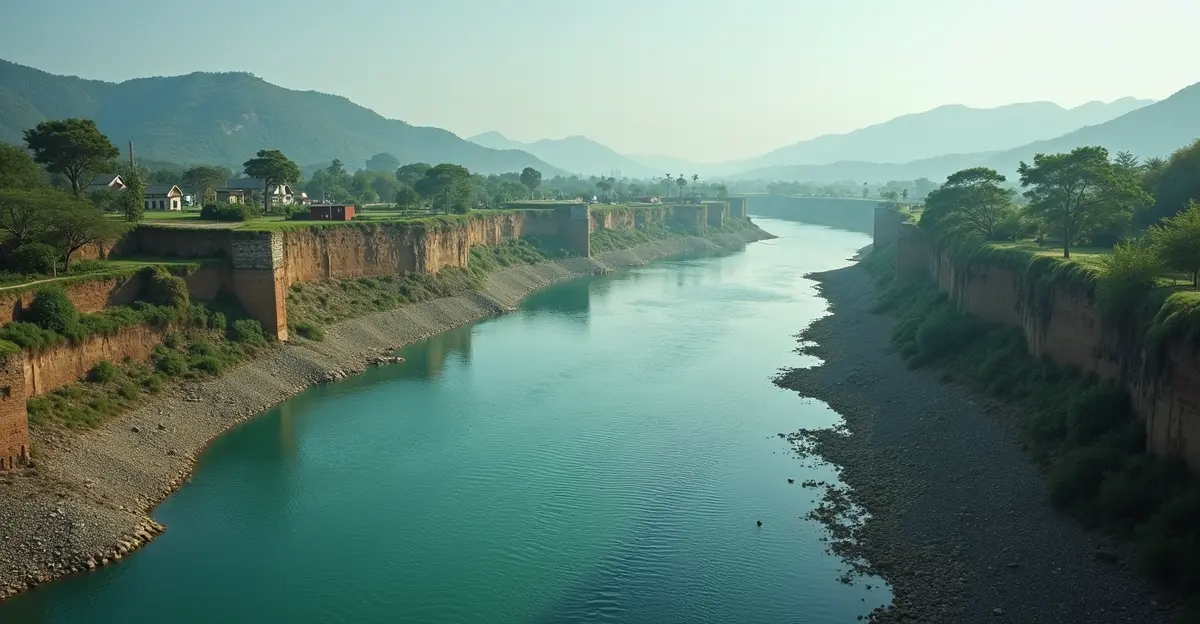
The most critical flashpoint remains the Nile River, where Ethiopia's Grand Ethiopian Renaissance Dam (GERD) now controls 90% of Egypt's freshwater supply. Egypt depends on the Nile for 99% of its population's water needs, creating what experts call a 'water bankruptcy' situation. The lack of binding multilateral agreements has created a powder keg scenario, with future projections showing further river flow reductions of 25-50% by 2025.
Indus River Tensions
The Indus River supplies over 80% of Pakistan's agricultural water, making it vital for food security and economic stability. Recent tensions between India and Pakistan over water sharing have escalated, with India suspending aspects of the Indus Waters Treaty following terrorist attacks. This river system represents one of the world's most critical transboundary water conflicts.
Middle East Water Weaponization
In the Middle East and North Africa (MENA), the world's most water-stressed region, 16 of the world's 25 most water-stressed countries face escalating crises. Turkey's dam projects have reduced Iraq's water supply from the Tigris and Euphrates by 80% since 1975, while Morocco's planned Kheng Grou dam could restrict water access to hundreds of thousands of Algerians. The Pacific Institute's Water Conflict Chronology 2025 Update documents increasing incidents where water is used as a weapon or target in regional conflicts.
Impact and Implications for Global Security
The convergence of water scarcity and infrastructure stress creates multiple security challenges. Water-related violence reached record highs in 2024, particularly in Ukraine, Russia, and Palestine, while West Africa faces weaponization of water by armed groups exploiting declining resources. The Lake Chad basin, affecting over 50 million people across four countries, has seen violent actors expand influence as water levels drop by 90% since the 1960s.
According to the Circle of Blue 2026 analysis, water is emerging as a critical global risk and potential strategic weapon, moving from environmental concern to geopolitical leverage. The World Economic Forum's Davos meeting now features water as a core agenda item, reflecting its growing importance in global governance discussions.
Expert Perspectives on Water Conflict Prevention
Military geography expert Francis Galgano warns that poor governance in vulnerable transboundary river basins combined with climate change effects are creating destabilizing conditions. 'While some experts see water as a potential bridge for peaceful negotiations, others warn that growing aridity and governance failures could lead to violent conflicts over diminishing water resources,' Galgano notes in his analysis of nine international river basins identified as potential flashpoints.
The World Bank's 2025 immersive story highlights how comprehensive water security initiatives in the MENA region are creating sustainable solutions, but emphasizes that nearly two-thirds of freshwater crosses national borders while over half of international river basins lack cooperative management agreements.
Frequently Asked Questions
What are the main causes of the global water crisis?
The primary drivers include climate change altering precipitation patterns, population growth increasing demand, unsustainable agricultural practices consuming 70% of freshwater, aging infrastructure failing to meet needs, and governance gaps in managing transboundary water resources.
Which regions face the greatest water conflict risks?
The highest-risk regions are the Nile River Basin (Egypt-Ethiopia-Sudan), Indus River Basin (India-Pakistan), Tigris-Euphrates system (Turkey-Syria-Iraq), Lake Chad Basin (Nigeria-Niger-Chad-Cameroon), and Central Asian river systems shared by multiple nations.
How does climate change worsen water scarcity?
Climate change intensifies water scarcity through altered precipitation patterns, increased evaporation rates, more frequent and severe droughts, melting glaciers reducing long-term water storage, and sea-level rise contaminating coastal aquifers with saltwater.
What solutions exist for water-stressed regions?
Effective solutions include improved water management and conservation, investment in modern infrastructure, wastewater recycling and desalination technologies, international cooperation frameworks for shared rivers, and sustainable agricultural practices that reduce water consumption.
How does water scarcity affect global migration patterns?
Water scarcity drives both internal and cross-border migration as communities seek reliable water sources, with the World Bank estimating that water stress could displace up to 700 million people by 2030, creating humanitarian crises and potential conflict over resources in receiving regions.
Conclusion: A Water-Secure Future Requires Global Cooperation
As 2026 unfolds, the global water crisis presents both immense challenges and opportunities for international cooperation. While water scarcity hotspots and stressed infrastructure create conditions for potential conflict, they also offer avenues for diplomatic engagement and collaborative solutions. The critical question remains whether nations will choose cooperation over confrontation in managing shared water resources. With proper investment in sustainable infrastructure, improved governance frameworks, and international cooperation, water can become a bridge to peace rather than a weapon of conflict. The coming years will test humanity's ability to manage this precious resource wisely, with implications for global security, economic stability, and environmental sustainability.

Follow Discussion