
 Deutsch
 English
 Español
 Français
 Nederlands
 Português

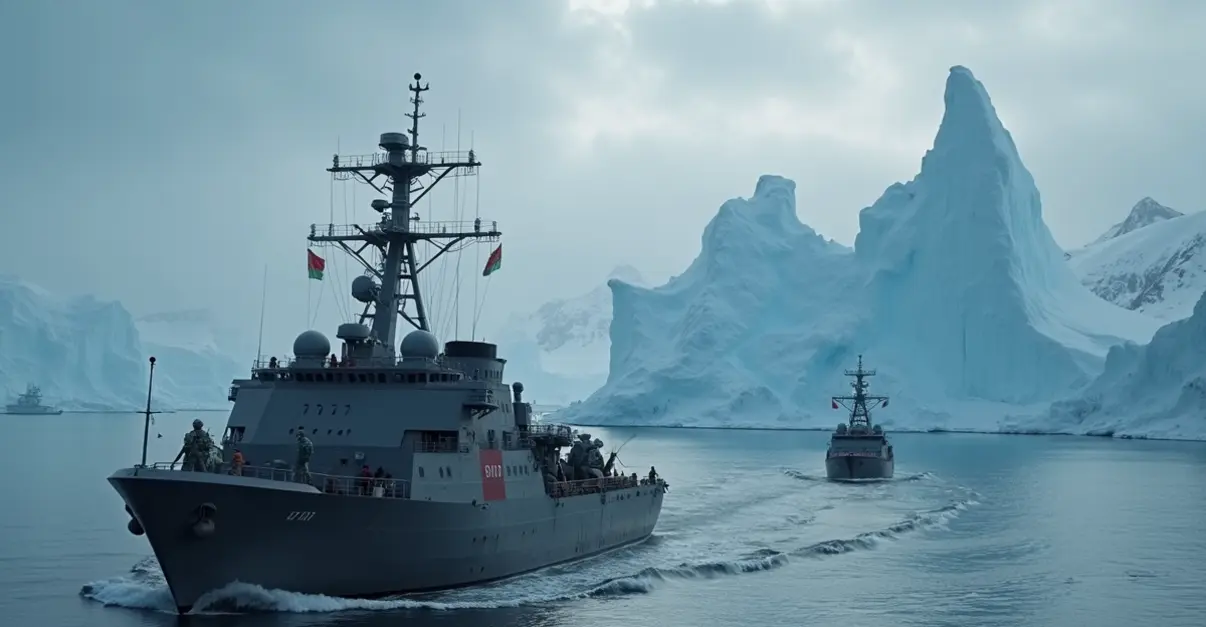





Trump Administration Escalates Push for Arctic Territory
The White House has confirmed that President Donald Trump continues to explore options for acquiring Greenland, with administration officials stating that military force remains 'always an option' for this foreign policy goal. This declaration marks a significant escalation in the administration's long-standing interest in the autonomous Danish territory, which Trump has repeatedly described as vital for U.S. national security.
National Security Justification
President Trump has framed the potential acquisition of Greenland as a critical national security priority. 'We need Greenland for our national security,' Trump stated recently aboard Air Force One. 'The location is so strategic. Right now there are Russian and Chinese ships all over there. We need Greenland for our national security and Denmark is not going to take care of that, I can tell you that.'
The administration's position was formalized by White House Press Secretary Karoline Leavitt, who emphasized that acquiring Greenland represents a key foreign policy objective. 'The president and his team are discussing a range of options to achieve this important foreign policy goal,' Leavitt stated. 'Utilizing the U.S. military is always an option at the Commander in Chief's disposal.'
Strategic Importance of Greenland
Greenland's geopolitical significance has grown substantially in recent years due to several converging factors. As the world's largest island with a population of just 56,000 mostly Inuit residents, Greenland sits at the crossroads of Arctic geopolitics. The territory contains substantial deposits of rare earth minerals essential for modern technology, including smartphones, electric vehicles, and military equipment.
Climate change has accelerated the melting of Arctic ice, opening new shipping routes and making previously inaccessible resources more available. This has intensified competition among major powers, with Russia expanding its military presence in the region and China declaring itself a 'near-Arctic state' and proposing a 'Polar Silk Road.'
The United States already maintains a significant military presence in Greenland through the Pituffik Space Base (formerly Thule Air Base), which serves as a crucial component of North American missile defense and space surveillance systems. According to military analysts, Greenland's location above the Arctic Circle makes it vital for guarding North Atlantic approaches to North America.
International Backlash and NATO Concerns
The Trump administration's statements have triggered strong international reactions. Denmark, which maintains sovereignty over Greenland's foreign and defense policy, has repeatedly rejected Trump's proposals. Danish Prime Minister Mette Frederiksen has warned that any U.S. military action against Greenland would effectively end the NATO alliance.
European leaders have rallied behind Denmark and Greenland. In a joint statement, leaders from the United Kingdom, France, Germany, Italy, Poland, Spain, and Denmark affirmed that 'Greenland belongs to its people, and only Denmark and Greenland can decide on matters concerning their relations.' This unified European response underscores the diplomatic tensions created by the administration's position.
Greenland's own government has been equally firm in its rejection. Prime Minister Jens-Frederik Nielsen stated unequivocally that 'Greenland is not for sale' and emphasized that only Greenlanders can determine their territory's future. Most Greenlanders favor eventual independence from Denmark but strongly oppose becoming part of the United States.
Alternative Approaches and Congressional Pushback
Administration sources indicate that while military options remain on the table, diplomatic solutions are preferred. One proposal involves purchasing Greenland from Denmark, though this has been repeatedly rejected. Another approach could involve establishing a Compact of Free Association similar to those the U.S. has with Palau, Micronesia, and the Marshall Islands, which would integrate Greenland into U.S. security and economic spheres without formal annexation.
Congress has expressed serious concerns about the administration's rhetoric. Senator Ruben Gallego has introduced a resolution to block any potential invasion of Greenland, while other lawmakers from both parties have warned that the U.S. must respect Denmark's sovereignty and territorial integrity. As noted in congressional briefings, the administration's position has created bipartisan unease about the potential damage to U.S.-European relations.
Broader Geopolitical Implications
The Greenland controversy reflects broader shifts in Arctic geopolitics. As climate change transforms the region, competition for resources and strategic positioning has intensified. Russia has been restoring Soviet-era military infrastructure in the Arctic, while China has increased its economic and scientific presence through what it calls 'polar scientific research.'
Political analyst Claes de Vreese of the University of Amsterdam expressed concern about the administration's approach. 'Greenland is a democratic country, an ally,' de Vreese noted. 'But we see how Trump does something without consultation and diplomacy.' He warned that if the U.S., as NATO's leading member, no longer takes the alliance seriously, it would represent an unprecedented development in transatlantic relations.
The situation remains fluid, with administration officials indicating that Trump wants his Greenland plan implemented before the end of his term. As one source told Reuters, 'This isn't going away.' The coming months will likely see continued diplomatic maneuvering as the administration pursues what it views as a critical national security objective while navigating significant international opposition.



Follow Discussion