


 Deutsch
 English
 Español
 Français
 Nederlands
 Português


 Share
Share




El Mencho Killing Explained: Mexico & US Face Cartel Violence Risks
The killing of Nemesio 'El Mencho' Oseguera Cervantes, leader of Mexico's powerful Jalisco New Generation Cartel (CJNG), represents a high-risk strategic move by both Mexican and American authorities that has triggered widespread violence across 20 Mexican states. The February 2026 operation, while dealing a significant blow to one of the world's most dangerous drug cartels, has unleashed retaliatory attacks that killed at least 25 National Guard members and left hundreds of Americans stranded in tourist areas, creating complex security challenges for both nations.
What is the Jalisco New Generation Cartel?
The Jalisco New Generation Cartel (CJNG) is one of Mexico's most powerful and violent criminal organizations, formed in 2009 after the collapse of the Milenio Cartel. Under El Mencho's leadership, the CJNG expanded rapidly to operate in 21 Mexican states and throughout the United States, generating an estimated $12.6 billion annually from drug trafficking, extortion, and other criminal enterprises. The cartel is known for extreme brutality, including using drones and rocket-propelled grenades in attacks, and was designated as a terrorist organization by the U.S. State Department in February 2025.
The High-Stakes Operation
On February 22, 2026, Mexican security forces with U.S. intelligence support killed El Mencho in a military shootout, ending the reign of one of Mexico's most wanted drug lords who had a $15 million U.S. bounty on his head. The operation followed months of intelligence gathering and coordination between Mexican and American agencies, including the Joint Interagency Task Force-Counter Cartel.
Immediate Aftermath and Violence
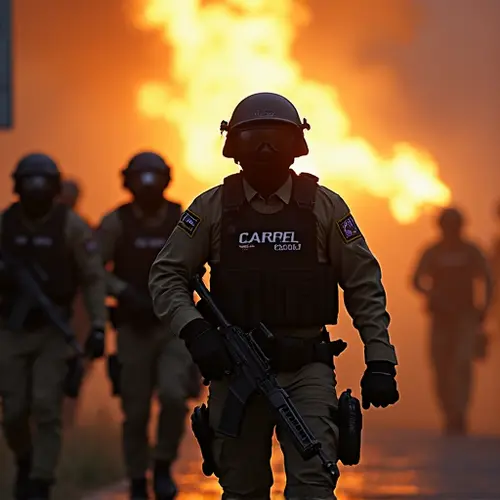
Within hours of El Mencho's death, coordinated reprisals erupted across Mexico. Cartel members burned vehicles, erected flaming roadblocks, and attacked security forces, killing 25 National Guard members in Jalisco alone. Schools closed in multiple states, airlines suspended flights to Jalisco airports, and hundreds of Americans found themselves trapped in popular tourist destinations like Cancún and Puerto Vallarta.
'I think it was absolutely the riskiest option that could have been considered at that time,' says David Mora, senior analyst for Mexico at the International Crisis Group. 'What they did with El Mencho will not only cause instability within the structure of the Jalisco cartel, but also with regard to the other smaller criminal groups active in Mexico.'
Political Risks for US-Mexico Relations
The operation presents significant political challenges for both nations. For President Trump, who has advocated for tougher action against drug cartels, the resulting chaos threatens American citizens abroad and could damage his political standing. The Mexican government under President Claudia Sheinbaum faces pressure from Washington to combat drug trafficking while managing domestic security concerns.
The situation echoes previous US-Mexico security cooperation challenges, where short-term tactical successes sometimes led to long-term strategic complications. According to CNN analysis, Trump cannot afford an approach that endangers Americans overseas, particularly with the 2026 midterm elections approaching.
Why Cartels Often Become More Violent After Leadership Loss
History shows that killing cartel leaders frequently leads to increased violence rather than dismantling criminal organizations. When El Chapo was arrested, the Sinaloa Cartel not only survived but grew stronger. Similarly, the CJNG itself emerged from the collapsed Milenio Cartel after its leaders were killed or captured.
'They have created a new generation that approaches things differently,' explains Carlos Pérez Ricart, expert at the Center for Economic Research and Teaching. 'They used a form of violence that was very calculated and instrumental. It was narcoterrorism.'
Analysts note that each new generation of cartel leaders tends to be more violent than the last, using increasingly gruesome methods including beheadings and public displays of bodies to intimidate rivals and authorities.
The Power Vacuum Challenge
The immediate concern is the power vacuum created by El Mencho's death. The CJNG operates through a decentralized structure with regional commanders who now face internal power struggles. Unlike more hierarchical organizations, the CJNG's network of smaller criminal groups could fragment into competing factions, potentially leading to prolonged violence as seen in Colombia after similar operations.
Todd Robinson, former Assistant Secretary of State for International Narcotics and Law Enforcement, emphasizes the need for comprehensive strategy: 'Mexico has traditionally not been good at that. The ruling party typically supports the governor or mayor who belongs to their party, and leaves opposition mayors to fend for themselves against drug cartels.'
Holistic Solutions Needed
Experts argue that a kingpin strategy alone is insufficient. A successful approach must include:
- Targeting mid-level cartel operatives who connect leadership with ground operations
- Disrupting financial networks through enhanced cooperation with U.S. financial intelligence
- Strengthening local governance and judicial systems to combat impunity
- Addressing economic drivers of cartel recruitment in vulnerable communities
The Colombian model from the 1990s offers lessons, where targeting high-level leaders was combined with expanding investigative capacity to expose hidden financial networks and strengthening the justice system. However, Colombia also experienced a power vacuum exploited by paramilitary and guerrilla groups who took over cocaine production.
Future Outlook and Security Implications
The coming months will test whether the CJNG undergoes orderly leadership succession or fractures into competing factions. The cartel's extensive resources – including an estimated 100 methamphetamine labs throughout Mexico – ensure it remains operational despite leadership changes. The U.S.-Mexico security relationship faces renewed scrutiny as both nations navigate the complex aftermath of this high-risk operation.
Similar to challenges faced with Central American migration policies, the El Mencho operation highlights the delicate balance between security objectives and humanitarian concerns in cross-border cooperation. The Mexican government's return to a 'kingpin strategy' after previously promising a 'hugs, not bullets' approach raises questions about long-term effectiveness and potential unintended consequences.
Frequently Asked Questions
Who was El Mencho?
Nemesio Oseguera Cervantes, known as El Mencho, was the leader of Mexico's Jalisco New Generation Cartel (CJNG), one of the world's most powerful and violent drug cartels with operations in 21 Mexican states and throughout the United States.
Why is killing cartel leaders risky?
Eliminating cartel leaders often creates power vacuums that lead to violent internal conflicts, fragmentation into competing factions, and increased brutality as new leaders seek to establish authority through extreme violence.
How does this affect Americans?
Hundreds of Americans are currently stranded in Mexican tourist areas due to violence, and the instability could affect cross-border trade, tourism, and security cooperation between the U.S. and Mexico.
Will the CJNG survive without El Mencho?
Most experts believe the CJNG will survive due to its decentralized structure, extensive financial resources, and operational capacity, though it may undergo significant internal reorganization and potential fragmentation.
What's next for US-Mexico security cooperation?
The operation demonstrates improved intelligence sharing and coordination, but long-term success requires addressing root causes including corruption, economic inequality, and strengthening judicial institutions in both countries.

Follow Discussion