Nederlands
 English
Boston Dynamics unveils production-ready Atlas humanoid robot at CES 2026, featuring industrial capabilities, Hyundai manufacturing partnership, and Google DeepMind AI integration for enterprise automation.
Enterprise Robotics Enters New Era with Atlas Launch
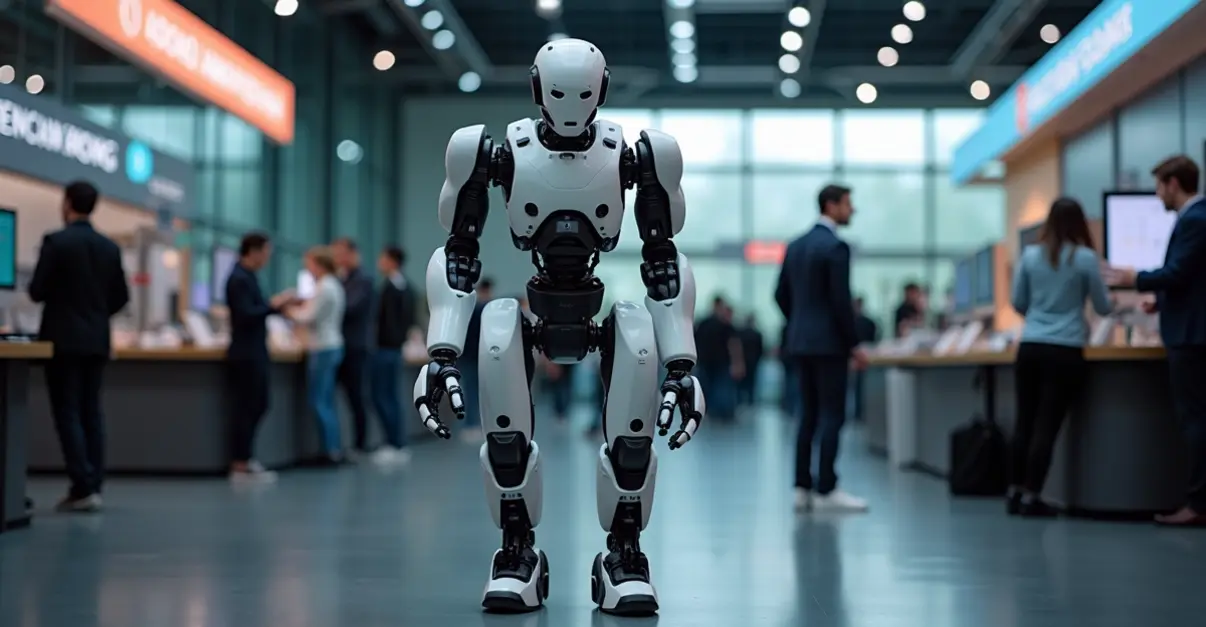
Boston Dynamics has officially unveiled the production version of its Atlas humanoid robot, marking a significant milestone in industrial automation. The announcement, made at CES 2026, represents the culmination of years of development and signals Boston Dynamics' transition from research-focused robotics to commercial enterprise solutions.
Designed for Industrial Applications
The new Atlas stands at 1.9 meters (6.2 feet) tall with an impressive 2.3-meter (7.5-foot) reach, designed specifically for manufacturing and warehouse environments. Unlike its hydraulic predecessor, this fully electric version boasts 56 degrees of freedom and can lift up to 50 kg (110 lbs) with ease. The robot operates in temperatures ranging from -20° to 40°C (-4° to 104°F), making it suitable for diverse industrial settings.
'Atlas is built to power the new industrial revolution,' said Boston Dynamics in their announcement. 'Our goal is to deliver value from Atlas' first steps with a customer through to scaled, skilled fleets.'
Hyundai Partnership Drives Manufacturing Scale
The launch is backed by Boston Dynamics' majority shareholder, Hyundai Motor Group, which plans to deploy tens of thousands of Atlas robots in its manufacturing facilities. According to CNBC reports, Hyundai will begin deploying Atlas robots at its U.S. factory in Georgia starting in 2028, initially for parts sequencing tasks before expanding to component assembly and complex operations by 2030.
'Hyundai understands what is required to deliver this transformation at scale,' Boston Dynamics noted, highlighting Hyundai's plans to build a new robotics factory capable of producing thousands of robots per year.
AI Integration with Google DeepMind
In a parallel announcement, Boston Dynamics revealed a groundbreaking partnership with Google DeepMind to integrate AI foundation models into the Atlas platform. The collaboration will combine Boston Dynamics' robotics expertise with Google DeepMind's Gemini Robotics AI models, enabling more sophisticated autonomous behaviors and environmental understanding.
'This partnership will enable humanoids to perform diverse industrial tasks, starting with automotive manufacturing,' the companies stated in their joint announcement.
Practical Features for Real-World Deployment
Atlas is designed for practical industrial use with several key features:
- Autonomous Battery Swap: The robot can swap its own batteries in under three minutes, enabling continuous 24/7 operations
- Safety Systems: Onboard safety systems detect people and vehicles, allowing for fenceless operation in busy workplaces
- Intuitive Controls: Operators can control Atlas using VR headsets, tablet controllers, or through the Orbit platform for fleet management
- Easy Maintenance: All limbs can be replaced in the field in under five minutes, with an IP67 rating for easy cleaning
Market Impact and Future Outlook
The Atlas launch represents Boston Dynamics' most significant commercial push since introducing Spot and Stretch robots. With Hyundai's manufacturing capabilities and Google DeepMind's AI expertise, the company is positioning itself as a leader in the emerging humanoid robotics market.
Industry analysts see this as a transformative moment for industrial automation. 'This isn't just another robot demonstration - it's a fully realized commercial product with clear industrial applications,' noted robotics industry expert Dr. Elena Rodriguez. 'The combination of Boston Dynamics' hardware expertise with Hyundai's manufacturing scale and Google's AI capabilities creates a formidable ecosystem.'
Boston Dynamics expects most customers to see return on investment within the first two years of adoption, with initial deployments beginning in 2026 and broader availability planned for 2027.