


 Deutsch
 English
 Español
 Français
 Nederlands
 Português


 Share
Share




What is the SpaceX Crew-12 Mission?
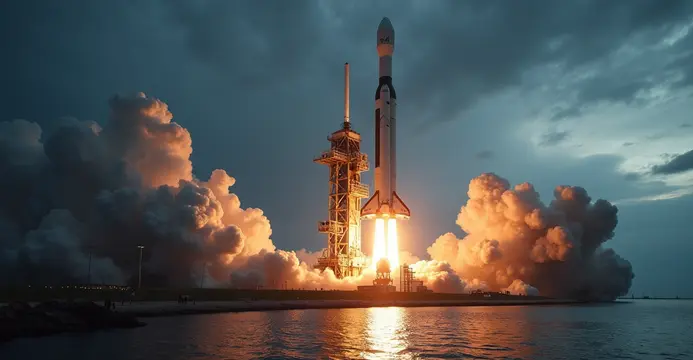
NASA's SpaceX Crew-12 mission successfully launched on February 13, 2026, marking the 12th operational crew rotation under NASA's Commercial Crew Program. After a two-day weather delay, a SpaceX Falcon 9 rocket lifted off at 5:15 AM EST from Cape Canaveral Space Force Station in Florida, carrying four international astronauts to the International Space Station for an eight-month scientific mission. The Crew Dragon spacecraft named 'Freedom' is transporting NASA astronauts Jessica Meir and Jack Hathaway, European Space Agency astronaut Sophie Adenot, and Roscosmos cosmonaut Andrey Fedyaev on a 34-hour journey to the orbiting laboratory.
Mission Background and Crew Details
The Crew-12 mission represents a crucial milestone in NASA's Commercial Crew Program, which has successfully restored American human spaceflight capability since 2020. This launch comes just weeks after the unprecedented early return of Crew-11 in January 2026 due to a medical emergency - the first such evacuation in the ISS's 25-year history. The current mission carries particular significance as it restores the station's full crew complement after the reduced operations period.
Meet the Crew-12 Astronauts
The four-person international team brings diverse experience to the ISS:
- Jessica Meir (NASA Commander): On her second spaceflight, previously spent 205 days on ISS during Expedition 61/62
- Jack Hathaway (NASA Pilot): First spaceflight, former Navy test pilot with over 2,500 flight hours
- Sophie Adenot (ESA Mission Specialist): First French female astronaut in space, aerospace engineer
- Andrey Fedyaev (Roscosmos Mission Specialist): Second spaceflight, experienced cosmonaut with previous ISS experience
Scientific Research Objectives
During their eight-month stay, the Crew-12 astronauts will conduct groundbreaking research across multiple disciplines:
Medical and Biological Studies
The crew will investigate how pneumonia-causing bacteria (Streptococcus pneumoniae) can lead to long-term heart damage in microgravity, where bacteria demonstrate increased virulence. This research has implications for both space medicine and terrestrial healthcare. Another experiment focuses on blood flow dynamics during spaceflight, examining how physical characteristics affect cardiovascular adaptation to microgravity.
Life Support and Food Production
A critical technology demonstration involves testing an on-demand intravenous fluid generation system that creates saline solution from potable water - essential for medical treatment during long-duration missions. The astronauts will also study plant-microbe interactions for nitrogen fixation, advancing sustainable food production systems for future lunar and Mars missions.
Automated Systems Research
The mission includes automated plant health monitoring experiments that could revolutionize agricultural monitoring both in space and on Earth. These systems use advanced sensors and AI algorithms to detect plant stress and optimize growth conditions without constant human intervention.
Launch and Docking Timeline
The Crew-12 mission followed this precise schedule:
- February 11, 2026: Initial launch attempt scrubbed due to unfavorable weather conditions
- February 13, 2026, 5:15 AM EST: Successful launch from Cape Canaveral Space Force Station
- February 13, 2026, ~5:23 AM EST: First stage booster successfully lands at Landing Zone 40
- February 14, 2026, ~3:15 PM EST: Planned docking with ISS Harmony module
- February 14, 2026, ~5:30 PM EST: Hatch opening and crew welcome ceremony
Historical Context and Significance
This mission occurs during a transformative period for human spaceflight. The Crew-12 launch represents the continuing success of NASA's partnership with commercial providers, following the Boeing Starliner delays that have kept SpaceX as the sole operational crew transportation provider. The mission also demonstrates international cooperation despite geopolitical tensions, with American, European, and Russian space agencies collaborating on the ISS.
'This launch represents the continuing evolution of our commercial space partnerships,' said NASA Administrator Bill Nelson in a statement. 'Every mission builds our capability for the Artemis program and future Mars exploration.'
Operational Impact on ISS
The Crew-12 arrival restores the ISS to its normal seven-person crew complement after several weeks of reduced operations. Since the early return of Crew-11 in January, only three astronauts - two Russians and one American - have been maintaining the station. This reduced crew size limited scientific research and increased workload for the remaining astronauts.
The new crew will join Expedition 74/75 and conduct approximately 250 scientific investigations during their stay. They'll also perform critical station maintenance, support upcoming cargo spacecraft arrivals, and prepare for future crew rotations.
Future Implications
The Crew-12 mission advances several key objectives for NASA's long-term exploration plans:
- Artemis Program Support: Research on medical treatment and life support systems directly informs lunar mission planning
- Commercial Space Development: Continues demonstrating reliable commercial crew transportation
- International Partnership: Maintains crucial cooperation between space agencies
- Technology Validation: Tests systems needed for future deep space missions
Frequently Asked Questions
What caused the Crew-12 launch delay?
The initial February 11 launch was scrubbed due to unfavorable weather conditions at Cape Canaveral, including high winds and cloud cover that violated launch safety criteria.
How long will Crew-12 stay on the ISS?
The astronauts are scheduled for an eight-month mission, returning to Earth in October 2026 after conducting extensive scientific research.
What makes this mission historically significant?
Crew-12 marks the 12th operational crew rotation under NASA's Commercial Crew Program and restores full ISS operations after the first medical evacuation in station history.
What research will benefit people on Earth?
Studies on bacterial virulence, cardiovascular adaptation, and plant-microbe interactions have direct applications for medical treatments, heart health, and sustainable agriculture.
How does this mission support future Mars exploration?
The life support systems, medical research, and food production experiments directly address challenges of long-duration spaceflight essential for Mars missions.



Follow Discussion