


 Deutsch
 English
 Español
 Français
 Nederlands
 Português


 Share
Share




The 2026 U.S. midterm elections are unfolding as the first major American election in which commercially available AI tools can produce convincing deepfakes in under an hour for less than $100 — and there is virtually no federal regulation governing their use. With Congress gridlocked, the Federal Election Commission deadlocked and inoperative since May 2025, and only a patchwork of state disclosure laws left standing, the governance gap between AI capability and election integrity has never been wider.
The Governance Vacuum: Why Nobody Is in Charge
The FEC, the agency tasked with overseeing federal elections, has been paralyzed by a 3-3 partisan deadlock and lost its quorum entirely under the second Trump administration. It has not issued a single binding rule on AI-generated political content. Meanwhile, Congress has failed to pass any comprehensive AI election regulation despite multiple bills being introduced. The TAKE IT DOWN Act, signed in May 2025, criminalized nonconsensual intimate deepfakes but pointedly excluded political speech. The DEFIANCE Act, which would let deepfake victims sue for damages, passed the Senate in January 2026 but languishes in the House. The NO FAKES Act remains stuck in committee.
"We are heading into an election where the tools of deception have never been more powerful and the rules of the road have never been more absent," said a senior election integrity watchdog official, speaking on background. "Every campaign knows this. Every foreign adversary knows this."
Deepfakes on the Campaign Trail: Documented Cases from Both Parties
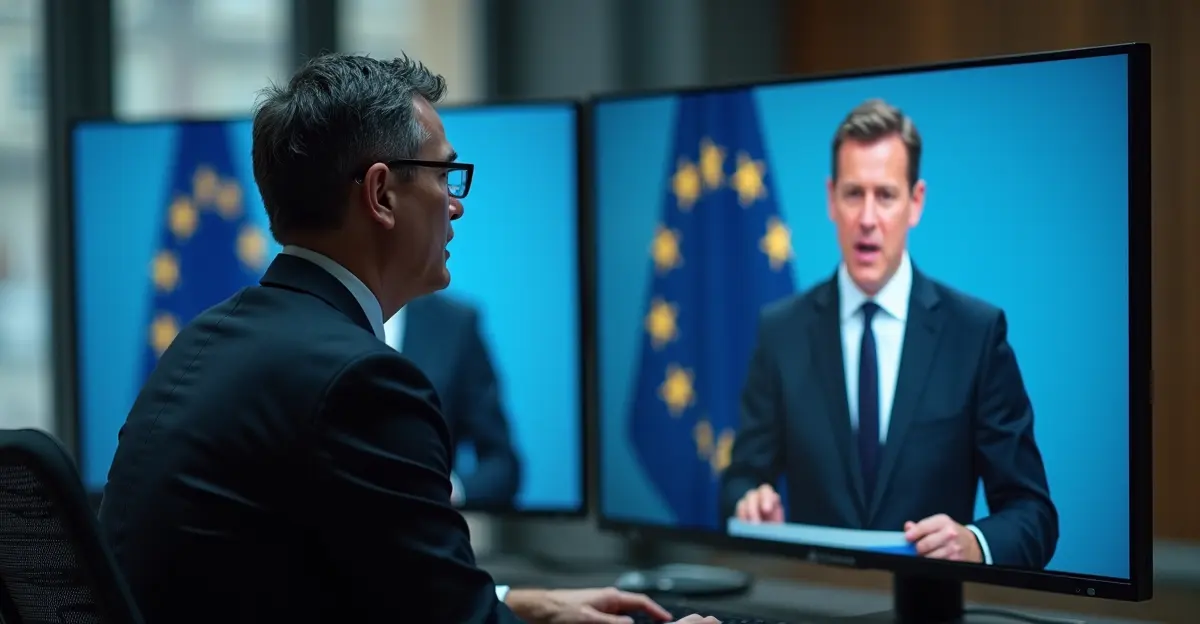
The 2026 cycle has already produced a cascade of incidents. In November 2025, Republican Representative Mike Collins of Georgia released an AI-generated video depicting Democratic Senator Jon Ossoff saying things he never said, part of a heated Senate race. Andrew Cuomo's New York City mayoral campaign briefly posted — then deleted — a racist AI-generated attack ad. In Virginia, Republican lieutenant governor candidate John Reid live-streamed a 40-minute "debate" against an AI deepfake of his Democratic opponent, State Senator Ghazala Hashmi, after she declined real debates. In Texas, Senate Republicans produced what experts call the most realistic political deepfake seen in a U.S. campaign to date: an AI-generated version of State Representative James Talarico for an ad he never filmed.
These are not fringe experiments. According to campaign analytics firm AdImpact, AI now powers approximately 30% of political advertisements, up from roughly 10% in 2024. Total 2026 political ad spending is projected to reach $14 billion. AI-generated radio spots cost under $200, compared to $2,000-$5,000 for traditional production — a cost collapse that lets even small campaigns and outside groups flood local markets with hyper-personalized synthetic content.
The Corruption of the Democratic Feedback Loop
The deeper threat is not any single deceptive video but the systemic erosion of the democratic feedback loop. Three dynamics are converging dangerously.
First, hyper-personalized micro-targeting: campaigns now deploy AI to generate thousands of message variants tailored to individual voter profiles, making it impossible for journalists, opponents, or regulators to monitor what different constituencies are being told. This is synthetic media deployed at scale, with no public record.
Second, AI-generated grassroots campaigns — or "AI astroturfing" — are flooding comment sections, social media platforms, and petition drives with fabricated citizen voices. In March 2026, California lawmakers formally urged the state attorney general to investigate AI-driven astroturf campaigns targeting state-level policy debates. A WIRED investigation revealed that a super PAC funded by OpenAI, Andreessen Horowitz, and Palantir executives ran petition campaigns disguised as grassroots activism to oppose state AI regulation.
Third, and most insidiously, the "liar's dividend" is now operational: politicians accused of genuine misconduct simply dismiss real evidence as AI-generated. In 2026, a real video of Israeli Prime Minister Benjamin Netanyahu was widely dismissed as fake during the Iran war escalation. The same dynamic is already appearing in U.S. races, where authentic recordings are waved away as deepfake detection failures, hollowing out accountability.
The State Patchwork: 28 Laws, Zero Consistency
States have moved faster than Washington. Twenty-eight states now have political deepfake laws on the books, up from just five in 2023. But the patchwork is brittle. Most require only disclosure labels rather than outright bans. Texas prohibits deepfakes within 30 days of an election. California's AB-2839, which imposed a broader ban, was permanently enjoined by a federal court on First Amendment grounds. The FCC has banned AI-generated robocalls but has no jurisdiction over social media or digital ads. Detection tools, meanwhile, remain only 60-70% accurate against modern generators, and the gap between generation and detection continues to widen.
What This Means for 2028 and Global Democracies
The 2026 midterms are a preview of the 2028 presidential cycle — and a warning for democracies worldwide. A 2025 CIVICUS report documented deepfake election interference across multiple continents, from Slovakia to Indonesia to Argentina. The asymmetry is brutal: creating a convincing deepfake takes hours and costs pocket change; debunking one takes weeks of forensic work and institutional trust that may not exist.
"The question is no longer whether deepfakes will affect elections," said a researcher at the Center for Security and Emerging Technology. "The question is whether our information environment can survive the volume. A single deepfake dropped 48 hours before polls close, in one swing district, could be enough."
FAQ
What is a deepfake? A deepfake is an image, video, or audio recording generated or altered using artificial intelligence to depict a real person saying or doing something they never said or did. Modern deepfakes leverage generative adversarial networks (GANs) and diffusion models to achieve near-photorealistic results.
Are deepfakes illegal in U.S. elections? There is no federal law banning or regulating deepfakes in political advertising. Twenty-eight states have passed their own laws, but most only require disclosure labels, and some have been struck down by courts on First Amendment grounds.
Why is the FEC not regulating AI political ads? The FEC has been deadlocked 3-3 along partisan lines and lost its operating quorum in May 2025. Without a quorum, the commission cannot open new rulemakings, issue advisory opinions, or enforce existing regulations on AI-generated campaign content.
Can deepfake detection tools reliably identify fake content? No. Current detection tools achieve only 60-70% accuracy against state-of-the-art generators, and accuracy degrades significantly on compressed social media video. The generation-detection gap is widening as AI improves.
What is the "liar's dividend"? The liar's dividend refers to the phenomenon where public figures exploit public uncertainty about deepfakes to dismiss genuine, incriminating evidence as AI-generated — weaponizing the very existence of deepfake technology to escape accountability.

Follow Discussion